
Memories of Jaffna days.
(I translated this using ChatGPT. Please let me know if there are any unnecessary parts or anything that needs to be corrected. I’d appreciate your feedback. Thank you!)
After the COVID pandemic, Gauthi and I (Gauthi was a Tamil girl from my batch; that’s the affectionate nickname I used for her) carried out our research at the Iranamadu Research Center.
For the first three years of university, we survived on the inexpensive meals from the campus canteen. But when we had to go out for field research in our fourth year, we quickly realized how expensive food was outside. So we started buying a single meal from a place called “Ainkayan” and sharing it between the two of us.
After spending long hours working under the scorching sun in onion fields and peanut fields, we would go to Ainkayan in Iranamadu for lunch.
The owner was a tall, heavily built man who looked quite stern.
The three men working there also looked equally intimidating.
We would sit at a table in the corner, split one meal in half, eat quietly, and then head back to our research work.
Water filled whatever space remained in our stomachs.
There was no dinner afterward. Or, at best, we ate only occasionally.
That was our life.
On the third day, one of the workers who had been watching us came over.
He asked Gauthi something in Tamil.
She answered him hesitantly in Tamil.
“What did he ask?” I asked.
“He asked why we’re sharing one meal between the two of us.”
The man then went straight to the cashier and said something.
I immediately thought, “That’s it. We’re probably not welcome here anymore.”
A little while later, he returned.
In his hands were all the curry dishes available in the shop.
He placed every single one of them on our table and said,
“Take as much as you want and eat.”
Then he walked away.
Days passed.
Weeks passed.
Months passed.
Our research lasted six months.
For the entire six months, we paid for only one meal, but every day those curry dishes would appear on our table so that we could eat our fill.
The man who did that was a Tamil man.
Since we couldn’t keep taking advantage of their generosity every day, we eventually started eating at the Iranamadu cafeteria.
Some days, after spending long hours in the field, we’d arrive very late. We never knew whether any food would still be left.
Sometimes there wasn’t.
On those days, the woman who worked in the kitchen would bring out fish curry she had quietly set aside because we hadn’t come yet. She would warm it up and serve it to us.
I didn’t know her.
She didn’t know me.
Yet there was some strange bond between us.
She was also a Tamil woman.
One weekend, when the cafeteria was closed, we went to the Iranamadu market to buy a little rice and some vegetables to cook for ourselves.
We didn’t have enough money to buy a coconut.
I picked one up, asked the price, and quietly put it back.
An elderly Tamil man who owned the shop noticed.
He said,
“Take it. Take it. No money needed. Take this too.”
And he placed a packet of curry spices in my hand.
He was a Tamil man too.
One day, just for fun, we climbed a cashew tree near the indoor stadium and picked some cashews.
The next day, Kesavan Anna brought me a bucket full of jackfruit.
Even today, some people remember me because of that famous bucket of jackfruit.
The person who brought me that bucket filled with kindness was also a Tamil man.
Sometimes, when we passed by the juice bar, the sister and brother who worked there would call us over and hand us a bag of buns. There were plenty of days when those buns and a cup of tea were enough to get us through.
They, too, were Tamil people.
I believe that everything depends on who we are as human beings.
Once, because I really wanted to see grape vineyards, I went looking for them in Jaffna. Visitors weren’t allowed inside. When I spoke to the workers there, one man looked at my face for a moment, then opened the gate and said,
“Have a look and leave quickly.”
He let me enter the vineyard.
And as if that wasn’t enough, another Tamil man picked two or three bunches of grapes and placed them in my hands.
Even today, I know that if I boarded a bus to Jaffna right now, got off at Point Pedro, walked up to a certain gate, and said,
“I came without telling anyone.”
there would still be a home waiting for me.
A home where they would say,
“Come in, come in. Think of this as your own home. Have you eaten? Shall I make you some tea?”
I have a family there who would tell me,
“Don’t leave so soon. Stay for another two or three weeks before you go.”
A family that would happily keep me with them for weeks.
Whenever I go to Jaffna and tell my younger brother there, “I’ve arrived,”
he replies,
“Akka, you’ve come? I’ll be there this evening.”
And he shows up carrying a parcel full of sesame sweets and other treats made by his mother.
Once, in my broken Tamil, I asked,
“Sharu, can I go to my uncle’s house with Amma?”
And Sharu’s mother smiled and said,
“Sari, sari… parava illai.”
(Okay, okay… that’s fine.)
She, too, was a Tamil woman.
On the last day of one of my visits to Jaffna, I asked Sharu:
“Before we met, what did you think about Sinhalese people?”
Sharu gave me an answer that still makes me stop and think whenever I remember it:
“It is all about what your heart says.”
If her heart had not felt that way, we would never have become family.
If her heart hadn’t felt that way, we would never have become bound by a sibling-like bond.
As my trip was coming to an end and I was getting ready to leave, Sharu held Thisara’s hand and said,
“You are my Aththan.”
Who is Aththan?
That’s me.
In Tamil, Aththan is the term used for the man who marries your sister — a brother-in-law.
She hugged Thisara warmly and said,
“You’re my brother-in-law because she’s my sister.”
Sharu, too, is a Tamil person.
⸻
On a recent trip to Jaffna, I stopped to take a photo of an old Morris Minor parked beneath a large tree by the roadside.
An elderly man dressed in white came over, opened the car door for us, let us take photos, and even posed for pictures with us.
As we were leaving, he said,
“My daughters are all married and gone. There’s no one here with me now. When I saw you, I was reminded of my daughter. My house is nearby—come and visit anytime.”
As we drove away, Sellappa stood there waving at us, his eyes filled with tears.
⸻
About seven months later, I received a call from an unfamiliar number.
The voice on the other end said,
“I’m calling from Jaffna. You’re the daughter who gave me your number that day, aren’t you?”
When I replied,
“Ah, this is Sellappa!”
he burst into laughter and began asking about my life and how I was doing.
He couldn’t speak Sinhala, and I couldn’t properly speak Tamil.
So our conversation was translated by a Tamil man who worked at a ticket counter near Sellappa’s house and who spoke Sinhala, Tamil, and English fluently.
Both of them were Tamil people.
⸻
I think everything depends on how we choose to see the world.
What I brought back from Jaffna wasn’t just a degree.
I found some of the most beautiful people I’ve ever met in my life.
Even today, every few weeks, I receive a phone call saying:
“Kumariiiii… it’s time for you to come visit again…”
That’s Subramaniam Mama — the man who became a father figure to me in Jaffna.
Whenever I stayed there, he would be the one bringing me tea in the morning.
Holding the cup carefully with both hands, he would say,
“Kumari… I brought your tea.”
⸻
I’ve had plenty of nicknames throughout my life.
But the person who calls me “Kumari” is Subre Mama.
There’s something about it that touches my heart.
“Kumari” may be a very common Sinhala name, but the day he called me by that name, that word reached my heart in a way it never had before.
⸻
I’ve traveled all around Jaffna and spoken with Tamil people, yet language has never once been a barrier for me.
Whenever I found myself lost in Jaffna, it was the people of Jaffna who showed me the way.
The last time I went to Jaffna, I had my hair braided in a style that looked a bit like the Predator. A Tamil-speaking auntie, who knew only Tamil, took me into her village so that she could show it to me—a person who knew only Sinhala.
At first, the people who saw me looked at me curiously. But once the auntie proudly introduced me, they welcomed me warmly and brought me fruits and other things from their homes for me.
They were Tamil people too.
Everyone who was with me during those moments can testify that every one of these stories is true.
Even today, when I feel like running away somewhere, it’s not home I want to run to—it’s Jaffna.
The world is a very big place.
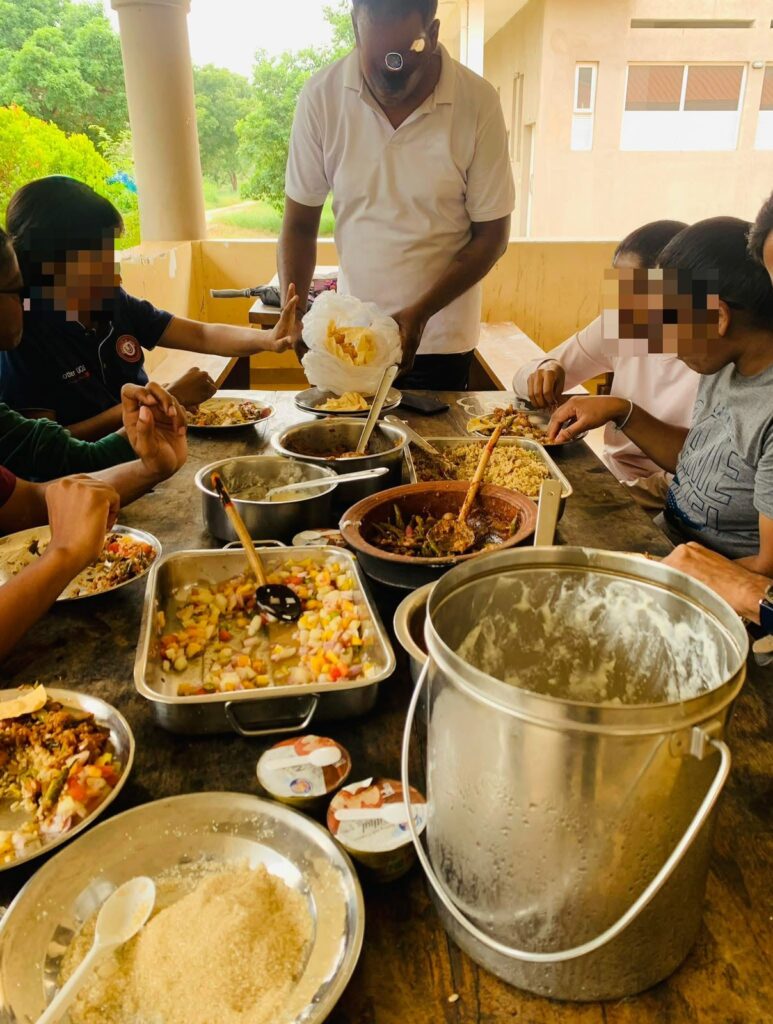
The photo below shows a meal that a Tamil man once gave us after an event at the university.
Even though the faces have been hidden, my friends who shared that meal with me will remember the incident.
Even when we said “no,” a few Tamil men brought every curry dish they had and piled them onto our table so that we could eat as much as we wanted.
I didn’t go to university just to stay within its four walls and then come home.
Compared to the whole of Jaffna, the university is just a very small place.
What I always tell the younger students who go there is this:
Step outside those gates and talk to people. They have beautiful stories to share.
Language is not a problem.
Even today, I still don’t speak Tamil well. But if I went to Jaffna right now, I have a home there.
These days, some people are judging an entire community because of an incident where a Vesak lantern was damaged at the Jaffna campus.
Whenever I see that, I remember the people I met throughout my life.
The man who brought all the curry dishes to our table when we were sharing a single meal between two people.
The elderly man who said, “Eduthu poonga” (“Take it, take it”) when I didn’t have enough money to buy a coconut.
The family who gave me a home in Jaffna.
And Subramaniam Mama, who still calls me “Kumari” to this day.
They were all Tamil people.
And that’s why I will never judge an entire community because of the mistake of a single person.
People should not be judged by the language they speak.
They should not be judged by where they were born.
It is all about what your heart says. That is the greatest lesson Jaffna taught me.
Original article in Sinhala and Tamil can be read here or here.